There is one bit of Bible that my children definitely know and learnt at a very young age. More than John 3.16 or John 10.10 or Psalm 23, or all those other very famous mountain top verses from scripture, as they were growing up they knew by heart Proverbs 6. 6. Along with a medley of other verses from scripture, bon mots and helpful sayings, I used to say it to them as they left for school each morning, shouting down the path after them – and if by chance some of you cannot immediately bring this verse to mind, let me refresh your memory –
“Go to the ant thou sluggard, and learn to be wise.”
This verse, is first of all, and incidentally, one of many examples in scripture where we learn wisdom, and are invited to learn wisdom, from close observation of the natural world and, therefore, I think we have to concede in today’s world, by implication, our lack of attention to the rhythms, patterns, perspectives and interconnected harmonies of that natural world is making us rather less wise than our predecessors and not nearly so clever as we like to think ourselves to be.
But that is incidentally; this address is not primarily about the environmental crisis we face and the challenge to the Church to offer our world a lead, telling a different and better story of how we live more lightly upon the earth and more harmoniously with the created world of which we are meant to be stewards. No, that’s not the purpose of this address, though these, of course, are vital, vital issues for the way we live Christ’s story together.
No, this address is really about what we can learn from observing the tiny ant, who, (to quote Frank Sinatra) can, with high hopes, move a rubber tree plant, and how their industry, purposeful collaboration and united effort give us a picture of what we can be and achieve when we work together, including and honouring each part of that Body which is the Church of Jesus Christ.
Last week on the back of some teaching engagements at the General Seminary in New York, Rebecca and I had a bit of holiday, which was great, and we visited the New York Museum of Modern Art, and there is in there at the moment, a wonderfully powerful video installation of a colony of ants cleaning up litter after a concert, fragment by tiny fragment. I also remember, I don’t know whether any of you read that book when it came out 20 years or so ago by Brian Keenan, An Evil Cradling, and where he’s telling the story of the harrowing account of his long, long incarceration. And there’s a wonderful passage in the book where his close observation of the ants, with whom he shares the cell and the way they worked together, gave him great hope in isolation, hope that we human beings could also find a way of collaborating purposefully with each other.
And I know this is a theme we have returned to many, many times in the past year, but it is one of the central themes of scripture and it is something that we need to choose and work at each day, valuing the gifts and giftedness of each person, honouring those who could easily be left behind or excluded, recognising how much more we can achieve when we work together, acknowledging that we belong to each other through our baptism and that we are less the Church that God wants us to be and the Church God shows us in Christ, when we give in to division, when we go it alone. And again and again, scripture suggests that observing ants, considering lilies, looking at birds, may be a better source of wisdom to consult than Co-Pilot and ChatGPT: “Go to the ant, thou sluggard, and learn to be wise.”
Our conference next month will provide a wonderful opportunity for deepening this sense of belonging and common purpose, and I am so looking forward to it and so grateful for those who are putting it together. And there are, of course, other things on our agenda this morning that invite us to find common purpose, common goals and better ways of working together.
The other thing I notice about ants, which I also notice in huge shoals of fish, and with those amazing, beautiful murmur of starlings in the autumn sky, is that it doesn’t appear that anyone is in charge. There’s not a CEO ant or a chief executive starling. They work together. Each knows its place, each has a role and a specialism. They are interdependent and adaptable. Ants are even able to build huge living bridges over obstacles in their path. Leadership is either constantly swapping from one to the other, or is somehow collectively held by the whole and communicated in purposeful partnership. I’m afraid we are at the far limits of my knowledge of ants. And no, I didn’t spend hours researching about ants online. So I’m afraid I can’t tell you anymore or quite how it happens. But this is what I notice.
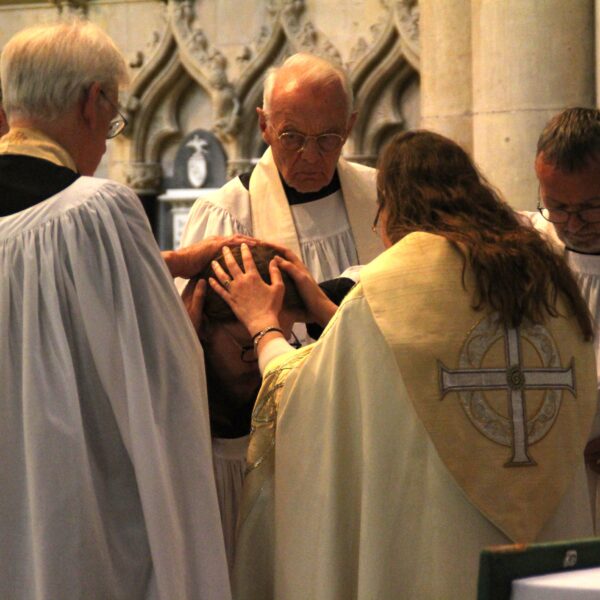
Within the Body of the Church, it is both the same and different. Because of our baptism we aspire to that beautiful close working together with leadership and ministry expressed by the whole; but we also know that Christ is our Head and that the Holy Spirit is our Guide. And within our own tradition – and I say this especially mindful that new deacons and priests will be ordained in our diocese next week – God raises up women and men to exercise particular responsibilities with and for the whole.
Please pray for those of us who have received this calling. That we may be humble, wise and purposeful in our oversight of the Church. And that we hold to our vision of ministry belonging to everyone. To the whole people of God.
Please pray for those who are to be ordained next week. Please pray that God will raise up more ministers of the gospel, both lay ministers and ordained ministers, and that we can really nurture this vision that all of us have a share in ministry, flowing from and serving that common vision, where together we are called to be a royal priesthood, a holy nation, a spiritual house, a blessed colony of ants, a murmur of starlings. All of us called to declare the wonderful deeds of him who has called us out of darkness into his marvellous light.