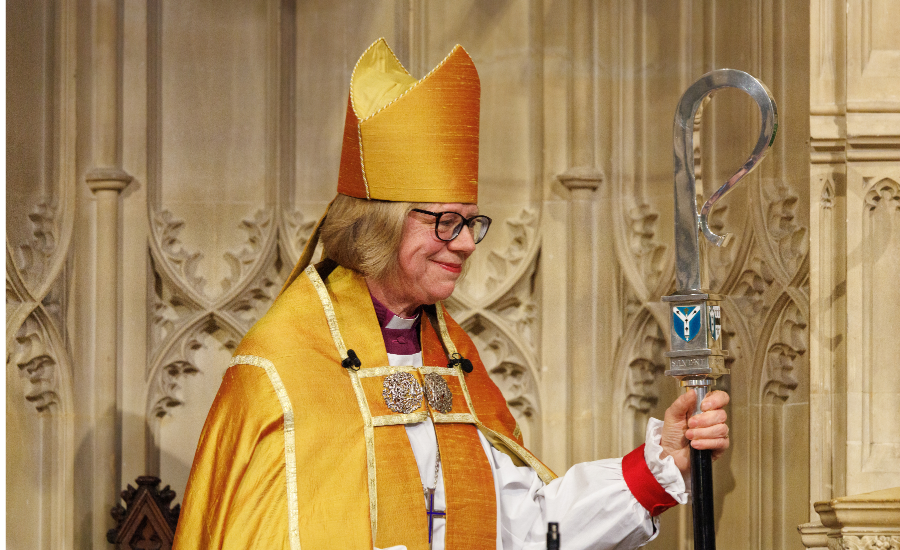
A Day of Calling and Welcome
Archbishop Sarah’s Installation took place at Canterbury Cathedral on Wednesday 25th March, the Feast of the Annunciation. On a day when the Church reflects on the calling of Mary, here we witness another woman responding to her call from God.
The purpose of this service is in welcome – the legal elements having already taken place on 28th January in the Confirmation of Election, this being confirmed at the beginning of the service before Archbishop Sarah requested entry, and in taking her seat in her diocesan cathedral. The word ‘installation’ itself refers to this process, literally being installed in a named stall, and in the case of Archbishop Sarah, in a Cathedra and in the Chair of St Augustine. Around these significant moments was a tapestry of symbolism, ritual, and joyful celebration.
There is something very moving about the beginning of a service of this kind, when the newly confirmed bishop or archbishop must request entry to their cathedral. The Dean and Chapter of each cathedral hold the responsibility for invitation and welcome to everyone who crosses over the threshold, and therefore, in each case, the bishop waits to be invited. As the congregation turned towards the West Doors, Archbishop Sarah used her crosier to knock three times, itself a symbol of humility and an overturning of dominating power to one which models servant leadership.
In the role of Archbishop of Canterbury, Archbishop Sarah was installed in two seats – in the Cathedra as Archbishop of Canterbury, and then in the Chair of St Augustine, which has been used for centuries as a symbol of the role of being Primate of All England and leader of the Anglican Communion.
Women at the Heart of the Service
As the first female Archbishop of Canterbury took her seat among the people, the role women played throughout the service was significant – women who spoke, who prayed, who sang, who danced, and even the powerful moment when women opened the West Doors after she knocked. This intentional yet beautifully natural participation of women on a world stage radiated joy as it honoured generations who pressed for women’s ordination and now glimpse its flourishing in shared ministry. The visible symbol of Archbishop Sarah within this service, being seated as the Archbishop of Canterbury itself sends a signal to women everywhere to see themselves with a place around God’s table.
“This intentional yet beautifully natural participation of women on a world stage radiated joy as it honoured generations who pressed for women’s ordination and now glimpse its flourishing in shared ministry.”
A Global Communion
The role of the Anglican Communion was also woven beautifully throughout the service. Global representation was offered with the Gospel reading in Spanish from the Primate of the Anglican Church of Mexico, a prayer in the language of Zambia from the Primate of the Church of the Province of Central Africa, and the presentation of a Compass Rose, the symbol of the Anglican Communion, by the Secretary General of the Anglican Communion. Within this representation of six languages was music, also wonderfully diverse, with a Kyrie sung in Urdu, the Gospel acclamation sung in Swahili, and the procession back into the Quire sung in Herero. This Gospel acclamation was particularly joyous, with the African Choir of Norfolk dancing at the front of the Nave, and singing in a way that you can feel deep within your soul.
Calling, Servant-leadership, and Unity
The framing of the service meant that calling, servant-leadership, and unity were all reflected in the choices of music. Each of the hymns had been chosen by Archbishop Sarah – Praise my soul, Thy hand O God has guided, Come down O Love divine, There’s a wideness in God’s mercy, and Tell out my soul – all well known, and all carrying a narrative which focusses our hearts and voices on praising God, on hope, and on naming a shared calling of humility. In singing as one people, ‘Let holy charity mine outward vesture be, and lowliness become mine inner clothing’; and, ‘For the love of God is broader than the measure of our mind… but we make his love too narrow by false limits of our own’, we invite those words to question us at depth: whether our common life is truly shaped by a love that is brave enough to cross boundaries and honest enough to face its own failures, a humility that listens before it speaks, and a commitment to justice that refuses to let anyone be hidden or diminished – so that the wideness of God’s mercy is not just something we affirm with our voices, but something we strive to make visible in the way we welcome, defend, and stand alongside one another.
It was poignant, too, using the words of Julian of Norwich in the anthem. To hear the words ‘all shall be well’ sung following Archbishop Sarah’s sermon, knowing the weight of the Office she now holds, was deeply moving.
“Pilgrim paths of faith”
After the Dean placed her in the Chair of St Augustine, Archbishop Sarah preached her first sermon. Woven beautifully throughout was a story of pilgrimage, tracing her recent journey from St Paul’s Cathedral in London to Canterbury Cathedral, noting that, “I make this journey with others and in the footsteps of the past… And not just on this ancient land, but all across the world, people walk the pilgrim paths of faith each and every day.” In this, she spoke powerfully of hope, that in our own journeys through life we trust that God walks with us, and that nothing is impossible with God.
This narrative of pilgrimage was illustrated too in the liturgical movement throughout the service – of people gathering in procession from across the world, Archbishop Sarah knocking on the door as she arrived, and movement around the building in prayers, readings, music, and liturgical action. Towards the end of the service, as we all prepared to be sent out to carry the Gospel into the world, Archbishop Sarah prepared the final part of our shared pilgrimage with words of commitment. This invited us all to serve together as people of many faiths, honouring God’s image in all people, cherishing the earth, and seeking the welfare of all people – all promises we find in other liturgical texts of God’s call to us as disciples in today’s world.
As we pray for Archbishop Sarah in her new ministry, let us remember the words from the aforementioned anthem using words of Julian of Norwich: “Without love we may not live. And in this love our life is everlasting. Love was without beginning, is and shall be without ending. All shall be well and all manner of thing shall be well.”